
Key Takeaways
- Pinwheel pallet loading is a technique that shuffles 48” x 40” GMA pallets in lengthwise and crosswise configurations to fit more freight in a 53 foot trailer. It’s usually around 28-30 pallets compared to the 26 you’d get from straight loading.
- It’s not whether pinwheeling is good or bad, but whether those extra labor hours, complexity, and potential damage risks make sense for your specific shipping lanes.
- Pinwheeling sacrifices dock speed for better space utilization, a trade-off that’s a no-brainer for long-haul trucking with standardized freight but often falls apart in less predictable LTL or multi-stop scenarios.
- There are a load of hidden costs to consider, including higher damage claims on turned pallets, weight distribution headaches that affect axle limits, and receivers struggling to navigate pallet jacks on crosswise pallets.
- Before committing to pinwheel pallets, try out a small-scale trial and factor in the real cost savings after accounting for labor, claims, and training costs.
What Is Pinwheel Pallet Loading in Trucking?
Pinwheel pallet loading is a common freight loading pattern where every other pallet is rotated 90 degrees inside a trailer. Instead of loading every pallet in the same direction, warehouses alternate between lengthwise and crosswise orientations to reduce wasted space and improve trailer cube utilization.
In a standard 53-foot dry van, this loading pattern can often increase capacity from approximately 26 pallets to 28-30 pallets, depending on pallet dimensions, product overhang, and trailer interior width.
While pinwheel loading can improve trailer utilization, it also affects loading speed, weight distribution, freight stability, and unloading efficiency. Whether it’s the right approach depends on your freight, shipping lanes, and operational priorities.
Here’s what that looks like:
- Standard 48” x 40” GMA pallets, arranged so one is lengthwise and the next is crosswise
- This method is mainly used for palletized loads in 53-foot dry vans and some 40-foot containers
- The goal is to fit more pallets than you would with straight loading, without fully turning the pallets and running into the trailer width constraints
How Pinwheel Loading Actually Works Inside a Trailer
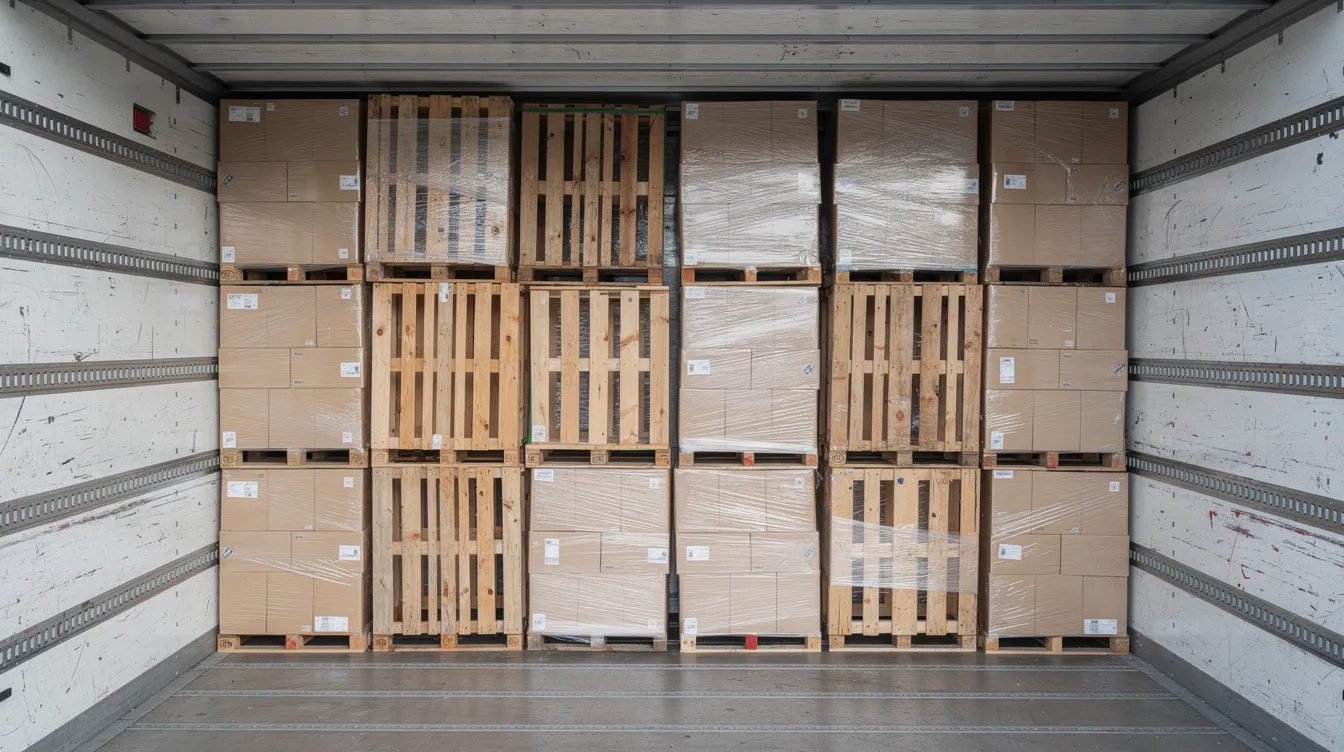
Pinwheel loading follows a simple alternating pattern. One pallet is loaded lengthwise, the next is rotated 90 degrees and loaded crosswise. That sequence repeats throughout the trailer to reduce unused floor space while maintaining load stability.
For standard 48″ × 40″ GMA pallets, this pattern can often increase trailer capacity from roughly 26 pallets to 28-30 pallets in a 53-foot dry van. The exact number depends on pallet overhang, packaging dimensions, trailer interior width, and overall load configuration.
Because every shipment is different, warehouses typically test the pattern before adopting it as a standard loading practice.
- Alternating rows: the first pallet goes in lengthwise against the front wall, the second pallet is turned and placed beside it, then you mirror that pairing across the trailer width
- Real-world constraints: overhang from stretch-wrap, corner protectors, and trailer interior width can add or subtract 1 or 2 pallet positions
- Pallet count range: you can fit about 26 pallets on the floor with straight loading, but pinwheeling can get you 28-30 under ideal conditions with minimal overhang
Step-by-Step Pinwheel Load Mechanics
Pinwheel loading is a repeatable pattern:
- Step 1 – Start at the nose: Load the first pallet lengthwise against the trailer nose.
- Step 2 – Build the alternating sequence: Rotate the second pallet 90 degrees and position it beside the first pallet.
- Step 3 – Standardize the layout: Repeat the alternating patterns across the trailer floor.
- Step 4 – Adjust for stability: Check pallet overhang and axle weights before completing the load.
- Step 5 – Account for handling: Secure the freight using the appropriate load bars, straps, or airbags.
Why Pinwheeling Might Not Always Be the Smart Play
Pinwheeling might look like free capacity, but it shifts the costs from transportation to your dock, warehouse, and claims department. The trade-offs are in four areas: labor and time, damage risk, weight distribution, and network complexity.
Think about this: saving one outbound truckload weekly by pinwheeling in 29 pallets instead of 26 looks like a no-brainer at $1,600 per load. But then you factor in the extra 10-15 minutes per trailer and the increased damage claims, that “free” capacity can get expensive in a hurry.
Labor and Dock Productivity Trade Offs
Pinwheeling usually slows things down by 20-30% compared to straight loading. Lift truck operators need to be more precise, work with reduced mass tilt angles, and take more time per pallet.
That tradeoff can show up in a few ways:
- Throughput takes a hit: 45-55 pallets/hour with straight loading drops to 30-40 pallets/hour when pinwheeling
- Time vs space: in peak periods, shaving off 3-4 minutes per trailer can be more valuable than gaining 2-3 pallet positions on the loading floor
- Dock congestion: having multiple forklifts working the same trailer can create congestion on the loading floor
Damage, Claims, and Packaging Trade Offs
When you load pallets turned, different faces of the cartons are exposed to lateral forces during braking and cornering. Some unitized loads are designed for front-to-back forces and can get damaged when turned.
- Real world example: a beverage manufacturer shipping pallets of bottles at 1,000-1,100 pounds sees higher corner crush and label damage on turned pallets unless they get extra bracing
- Higher risk freight: tall palletized loads stacked on top of display ready pallets with cartons suffer the worst from mixed orientations
In most cases, pinwheel loading requires stronger packaging. More wrap, better corrugate, and added support, which all drives up cost.
Weight Distribution, Axles, and Driver Safety
Pinwheeling messes with how weight sits across all three axes and that has a straight impact on load balance and compliance. When you’ve got pallets stacked unevenly with one side way heavier than the other that creates cross-axis imbalances that can make the driver feel like the load is swaying all over the place in the crosswind.
- Weight limits: U.S. federal limits are 80,000 pounds gross and 34,000 pounds per tandem axle
- Scales: In-cab axle scales (now the standard since 2022) help you test out different patterns before you even hit the road
- Fines: If your loads are consistently pushing any axle over the limits for equalized weight distribution, the fines will be way more expensive than any potential cube gains you’re making by pinwheeling
Network and Service Tradeoffs (TL vs. LTL, One-Stop vs. Multi-Stop)
Pinwheeling is a winner on one-pick, one-drop truckload jobs with standardized palletized loads. It completely falls apart in more complex networks.
- LTL problems: when they start restacking the freight at cross docks all the carefully built patterns get torn apart
- Multi-stop TL: A 4-stop route where they unload at the first stop and mess up the pattern, now you’re left with wasted empty space and you’re losing stability
When you’re loading palletized product for local and regional shipments, speed often wins out over trying to squeeze in every last bit of cube utilization
Pinwheel vs. Straight vs. Turned: Which Method Makes Sense for You
Choosing between other loading methods depends on the type of product you’re moving, the type of trailer or container, the length of the lane, and the handling conditions. Each loading method performs differently when it comes to space use, speed, and load stability.
Straight Loading
Straight load pallets with the 48” side running front to back means you can fit about 26 pallets in a standard 53 foot dry van. This is the fastest method, and it’s ideal for high volume operations where getting the load on and off the dock fast is the top priority.
- Easy to secure with load bars and straps
- Straightforward, no special equipment needed to get a pallet jack on there
- Leaves a bit of air on either side, about 4-6 inches, which doesn’t make the most of the space, but it also minimizes claims on specific loads.
Turned Loading (Sideways Pallets)
Loading pallets sideways positions the 40” side front to back. That’s fine as long as you’ve got a trailer that’s wide enough to accommodate it. Some of the 102” dry vans will work, but the refrigerated ones and the 40 foot ocean containers are often too narrow due to the insulation and air channels.
- Gives you a bit more lateral stability for tall loads that are pressing against the walls
- Not so great in floor load containers headed for export because it creates issues with the interior fittings
- Can help create a more balanced load when you’re dealing with tall loads that might otherwise start to lean
Pinwheeling: The Middle Ground
Pinwheel loading takes a bit from both sides, it uses the 48” and 40” sides in an alternating pattern to close the gaps. It’s a good option for when you’ve got very tight loading conditions where trailer width is a problem.
- You can realistically fit about 27-30 pallets depending on overhang, load height and pallet condition
- Wins on cube utilization but loses on operational simplicity
Safety and Load Securement in Pinwheel Pallet Loading
Safety requirements don’t change just because you’re using pinwheeling. A stable load can still lean and shift just like any other unitized load. You need to make sure your load securing equipment and procedures are up to the task for both straight and turned pallets.
Building a Safe Load
- Pallet quality: a damaged pallet stringer is going to translate into a barely stable configuration when you’ve got pallets interlocking at different angles
- Height limits: a load above 84” needs extra wrap, corner boards or caps to keep it stable
- Use friction mats for beverages and paper to prevent lateral movement of the load
- Document your SOPs with photos, so 3PLs can replicate the pattern safely
Securing the Load for Delivery
Position your load bars and straps so that they restrain both orientations, not just the forward facing units. Airbags fill the gaps between the pallets that pinwheeling creates near the rear doors.
- For containers headed to ports, consider making sure tall palletized loads are facing the right forces from the vessel and rail
- Claim example: Inadequate load bars on a pinwheeled beverage load shifted during hard braking, generating claims that exceeded the value of the extra stability you get from the pattern itself
Deciding If Pinwheel Pallet Loading Is Right for Your Operation
Before you go standardizing pinwheeling across your network, run targeted trials. The lightest loads and the most consistent products on your longest lanes are the best candidates.
Key Questions to Ask Before You Pinwheel
- Can your average pallet height, weight and packaging handle the mixed orientations and lateral forces?
- Is your lane profile suitable? Long haul TL on consistent routes, not complex LTL with many pallets changing hands is what pinwheeling is ideal for
- Are you running short on forklifts and dealing with slower loading times and resulting bottlenecks?
- Does your claims history show any existing problems with crushed or tipped loads that pinwheeling might make worse?
- Can the receivers handle pallets that have been turned, or are they going to need to reposition two pallets per trailer?
Frequently Asked Questions About Pinwheel Pallet Loading
Q: When should you avoid pinwheel pallet loading?
You should probably avoid pinwheeling for loads that are fragile or likely to get crushed, pallets of different heights, LTL shipments that have a lot of handling, and when receivers can’t safely deal with pallets in different orientations. If you’re already running a tight ship as far as damage goes, things only get worse when you start messing around with more complicated layouts.
Q: Can you use pinwheel loading in a reefer trailer?
Yeah, it does. Reefers need nose-to-tail airflow and pinwheel patterns can mess with that. And because they’re insulated, the inside of the trailer gets a little smaller, so you might end up with a trailer that’s too small for a full pinwheel pattern with 48″ x 40″ pallets. In the case of temperature-sensitive cargo, usually product integrity is a higher priority than trying to squeeze in a few extra pallets. If you’re shipping something that needs to be kept at a certain temperature, you should probably test out a pinwheel pattern before giving up and just doing the usual.
Q: How many pallets fit with pinwheel loading?
Some places say you can do 30 pallets, but the truth is most of the time you’re looking at 27-30 pallets for a standard GMA in a 53 foot trailer, depending on the situation. That’s a couple more than if you just go with straight loading. Before you start pinwheeling, though, you should take a trailer and mock it up with some pallets and check the axle weights to make sure you’re not going over the max weight.
Q: Can automated trailer loading systems do pinwheel patterns?
Most of the automated systems in high-volume DCs are geared around the regular old straight pattern. Getting the machines to do pinwheeling is a whole different ballgame, it requires some custom programming and pretty much perfect pallets every time. Lots of operators would rather just sacrifice a bit of space and keep things easy. Pinwheeling and automation just don’t mix well unless you’re willing to put in the time and money to get it right.
Q: How do you even go about modeling the cost savings from switching to pinwheel loading?
First, you need to figure out how many pallets you’re shipping in a load, how many loads you ship per week, and what the cost of each load is. Let’s say you’re shipping 520 truckloads a year and you can shave off 20 of those by using pinwheeling – that’s a $32,000 savings right there before you even factor in the extra labor and claims. Now you need to balance that out against the extra dock time, overtime, and all that other good stuff. Use your historical data from 2023-2025 to get a good idea of how load efficiency is going to pan out.